How to Calculate Streaming Royalties (and Split Them)
Search "how much does Spotify pay per stream" and the answers do not agree, because a fixed per stream rate does not exist. Most streaming services pay out a share of what they make from subscriptions and ads, divided up by who got the plays. So the value of one stream shifts with the listener's country, plan and month.
Then the money gets carved up again before it reaches you: a distributor or label cut, then shares for the producer, the feature and your co-writers. Here is how to estimate it and work out who gets what.
The quick way: estimate it in your browser
- Open the royalty calculator. On a first visit it starts with 100,000 Spotify streams filled in, so an answer is already on screen.
- In the box labeled total spotify streams on this song, type the song's total. Shorthand like 250k or 1.2m works, or tap a preset: 1k, 10k, 100k, 1M or 10M.
- For streams elsewhere, click + Add a platform and pick from ten more, such as Apple Music, YouTube Music, Amazon Music and TikTok, each with its own box and rate.
- Read the answer, which updates as you type: a low to high range, with the figure "at a typical rate" under it.
- Under who gets paid, tap Producer, Feature, Artist or Co-writer to add each person on the track. Each one starts at 0%, so type their share of the recording money in the master box. Your own share fills in the rest of 100% until you type over it.
- Under released through, pick who puts the song out: DistroKid, TuneCore at 0%, CD Baby at 9%, free plan at 15% or label at 80%. For any other deal, use the or type a cut box.
A few details worth knowing
- The answer is a range on purpose. Each platform has a low and a high rate, which the tool says come from 2024 to 2026 payout data. They are estimates, not quotes.
- Location moves the number. The tool's own warning: if your listeners are mostly in India, Brazil or Nigeria, expect about a third of the low figure.
- Spotify has a 1,000 stream line. Type fewer and the Spotify recording money drops to $0, with the note "Spotify pays $0 until a song has 1,000 streams in 12 months."
The calculator's ranges for five of its eleven platforms, for the recording, before any cut:
| platform | per stream |
|---|---|
| Spotify | $0.003 to $0.005 |
| Apple Music | $0.006 to $0.008 |
| YouTube Music | $0.004 to $0.008 |
| Amazon Music | $0.004 to $0.0088 |
| Tidal | $0.006 to $0.009 |
Splits: who gets paid, and in what order
A song earns money in two separate ways, and each has its own 100% to share out.
- The master is the money for the recording. Your distributor or label takes its cut first. What is left is shared by everyone with a piece of the recording: you, a featured artist, a producer with points (a percentage of that money).
- Publishing is the money for the song itself: the beat, the words, the melody. It goes to the writers, typically through a collection society, not your distributor. A co-writer can have a share here and none of the master. Switch on Count publishing (songwriting) money and the tool adds it on top, estimated for Spotify at a quarter of the master money. With two or more people on the split, each also gets a publishing box. The distributor's cut never comes off this side.
One worked example
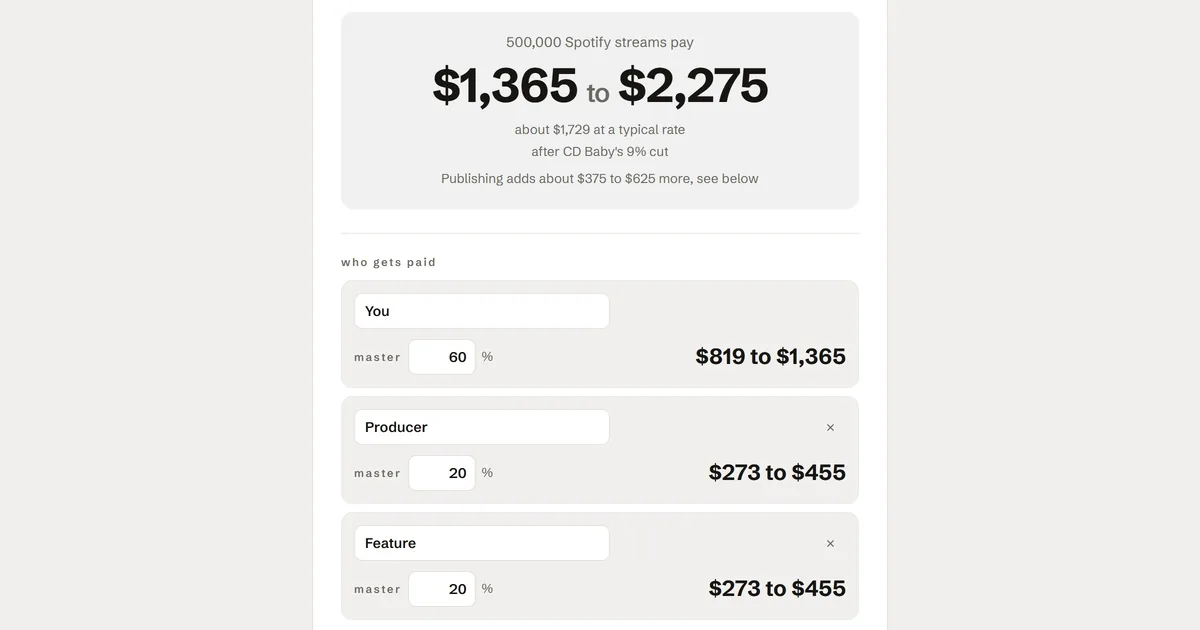
Say a song has 500,000 Spotify streams and went out through CD Baby. You keep 60% of the master, and the producer and the featured artist get 20% each. The writing is split 40% you, 40% producer, 20% feature. Here is the math the calculator does:
- 500,000 streams at $0.003 to $0.005 is $1,500 to $2,500 for the master.
- CD Baby's 9% comes off first, leaving $1,365 to $2,275.
- Publishing, a quarter of the master before the cut, is $375 to $625.
| person | master | publishing | total |
|---|---|---|---|
| You | $819 to $1,365 | $150 to $250 | $969 to $1,615 |
| Producer | $273 to $455 | $150 to $250 | $423 to $705 |
| Feature | $273 to $455 | $75 to $125 | $348 to $580 |
That is $1,740 to $2,900 between the three of you. Notice the order: the producer's 20% comes out after the cut, not before it.
In the tool, publishing starts as an even split, so type 40 and 20 into the producer's and the feature's publishing boxes to match.
Other ways to work it out
- Your distributor's reports. For money already earned, your distributor's report is the real figure. An estimate is for looking ahead, such as agreeing a split before release.
- Your own average. Divide what a platform paid you by the streams it reported for the same months. That number already reflects your listeners' countries and plans, so for your catalogue it is the better guide.
- Your distributor's split feature. The calculator moves no money. Several distributors can pay collaborators their percentage automatically, usually for the master side only.
- A split sheet. Write the percentages down and get everyone to sign before release.
Common mistakes
- Mixing the two pots. 50% of the publishing is not 50% of the master.
- Splits that do not add up. The tool says "Adds up to 100%." when they do, and shows what is left to assign or how far over you are when they do not. Split evenly gives everyone an equal share.
- Planning around the high end. Budget on the low number.
Before release, the loudness checker measures integrated LUFS and true peak, and cover art prep has a 3000 by 3000 cover preset.
Common questions
How much does Spotify pay per stream?
There is no set rate. The calculator works from $0.003 to $0.005 a stream for the recording, so $3 to $5 per 1,000 streams, before any cut or split.
How much do 1 million Spotify streams pay?
At that range, $3,000 to $5,000 for the master before any cut or split, or about $3,800 at the tool's typical rate. It estimates another $750 to $1,250 in publishing for the writers.
What split does a producer get?
Whatever you agree. The calculator's hint for a leased beat: producers usually get 0% of the master and 50% of the publishing. With an exclusive deal, producers often take part of the master as well.
When do streaming royalties arrive?
The tool's note says money lands 2 to 3 months after the streams, before tax. The exact timing depends on your distributor.
Put your own song's numbers into the royalty calculator before you agree to a split, and treat the result as an estimate, not a promise.